 TCB Pay Portal
 TCB Pay App
 ACH
Processing
ACH
Processing TCB Pay Issuing
 Alert & Notifications
 TCB Pay White-Label
 Integrations
 IT Solutions
 About
Us
About
Us Pricing
 Blog
Blog Security
 System Status
 Contact Us
 Sign in to TCB Pay Portal
 Sign in to TCB Pay Issuing

 Back to all articles


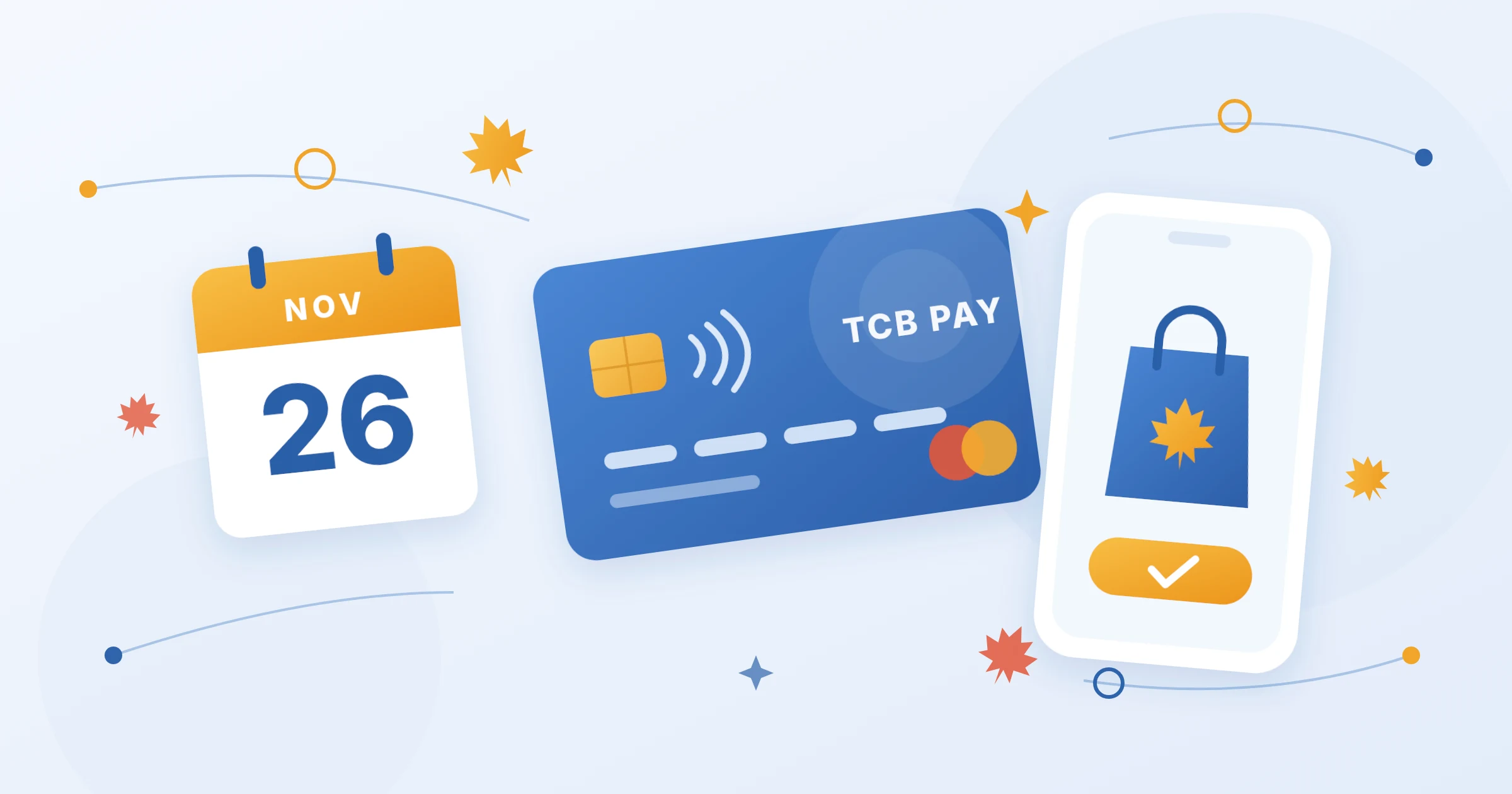
Thanksgiving is a day about gratitude, family, and far too much pie. But it's also one of the most powerful economic events of the year. In just a few days, Americans buy groceries, hit the road, and then open their wallets for Black Friday, Small Business Saturday, and Cyber Monday — kicking off a holiday season the National Retail Federation now expects to top $1 trillion.
Here at TCB Pay, we want you to walk into the busiest stretch of the year feeling prepared, not overwhelmed. So let's look at how Thanksgiving actually moves the economy, what changed in the way people pay, and what you can do now to turn that holiday traffic into secure, settled revenue.
Thanksgiving 2026 by the numbers
Mark your calendar — this year's key dates are:
- Thursday, Nov. 26 — Thanksgiving Day
- Friday, Nov. 27 — Black Friday
- Saturday, Nov. 28 — Small Business Saturday
- Monday, Nov. 30 — Cyber Monday
Because Thanksgiving falls a day earlier than in 2025, shoppers get one extra day between Thanksgiving and Christmas. And the outlook is strong: the NRF forecasts that November–December retail sales will grow 4.2% in 2026 to roughly $1.013 trillion, faster than last year's 3.1%. Shoppers are still being careful with household budgets, but they're clearly planning to prioritize the holidays.
It starts at the dinner table
Before a single gift is bought, Thanksgiving gets the economy moving through food and travel. According to the American Farm Bureau Federation, a classic Thanksgiving dinner for 10 cost $55.18 in 2025 — about $5.52 per person and roughly 5% less than the year before, the third straight annual decline.
That may sound modest, but multiply it across tens of millions of households and you get a huge surge for grocers, farms, bakeries, liquor stores, and restaurants. Add in flights, gas, hotels, and dining out, and the week before Thanksgiving becomes a high-volume period for hospitality and travel merchants too. If you run a restaurant, caterer, or local food business, this is your first rush of the season — not Black Friday.
Curious about the bigger picture? Our earlier piece on how Thanksgiving affects the economy covers the holiday's history and its ripple effect across industries.
The five-day shopping marathon
Once the dishes are done, the shopping begins. The NRF reported that a record nearly 203 million people shopped between Thanksgiving Day and Cyber Monday 2025 — about three out of every four U.S. adults — spending an average of around $340 each. Online shoppers (about 135 million, up 9%) now outnumber in-store shoppers (about 130 million, up 3%).
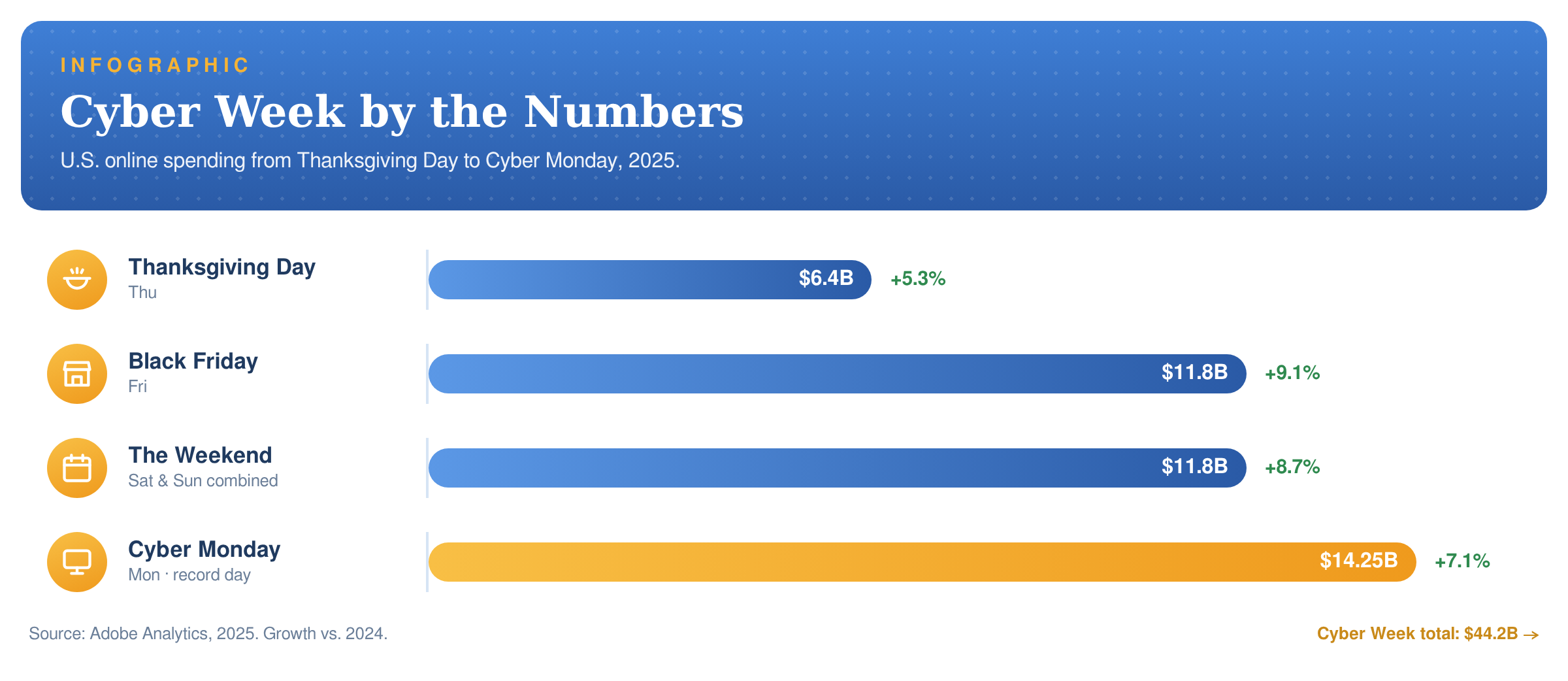
Adobe Analytics tracked how those five days played out online in 2025:
- Thanksgiving Day: $6.4 billion spent online (up 5.3%)
- Black Friday: a record $11.8 billion (up 9.1%)
- Cyber Monday: a record $14.25 billion (up 7.1%), peaking at about $16 million per minute between 8 and 10 p.m.
- Cyber Week total: $44.2 billion online (up 7.7%)
Read that again: $16 million every minute. When volume spikes like that, every declined card, slow checkout, or payment outage costs real money.
How shoppers will pay this year
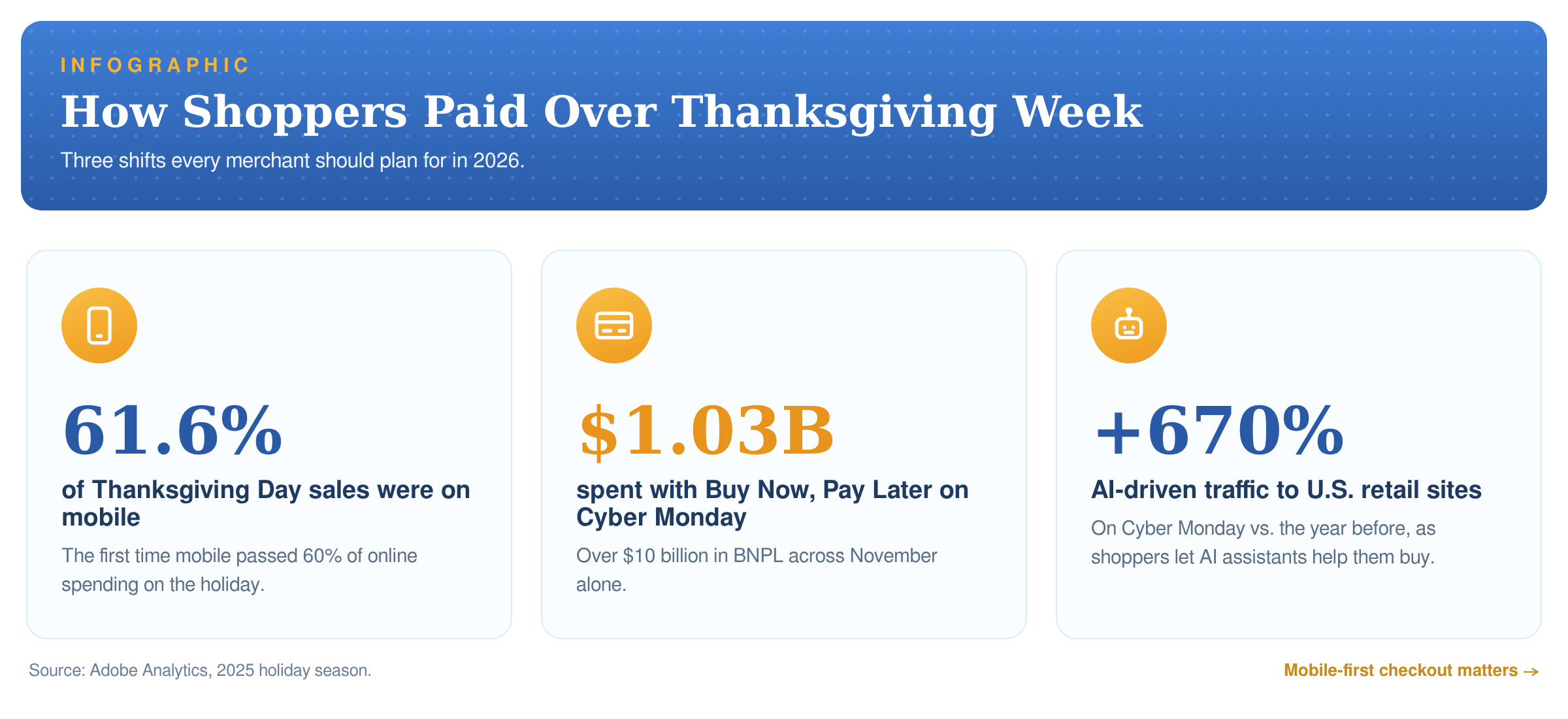
It's not just how much people spend over Thanksgiving week — it's how they pay. Three shifts stood out last year, and all three will matter even more in 2026:
- Mobile is now the default. On Thanksgiving Day 2025, 61.6% of online sales happened on a smartphone — the first time mobile crossed 60%. If your checkout is clunky on a phone, you're losing the majority of your shoppers.
- Buy Now, Pay Later keeps growing. Shoppers spent $1.03 billion using BNPL on Cyber Monday alone, and over $10 billion across November. Flexible payment options are no longer a "nice to have."
- AI is sending shoppers your way. Adobe saw AI-driven traffic to U.S. retail sites jump 670% on Cyber Monday. We broke down what that means for your checkout in our article on agentic commerce.
The hidden cost: fraud and chargebacks
Here's the part that doesn't make the headlines. The same conditions that make Thanksgiving week great for sales — high volume, rushed buyers, lots of first-time customers, and deep discounts — also make it a magnet for fraud. Card testing, account takeovers, and stolen-card orders all tend to hide inside holiday traffic.
And the damage often shows up weeks later, in December and January, when chargebacks roll in. Some are true fraud. Many are "friendly fraud" — a real customer who doesn't recognize a charge, never got a package in time, or simply regrets an impulse buy. Either way, you lose the sale, the product, and pay a fee on top.
In other words, the holiday rush isn't over when the sale is made — it's over when the money is safely yours. For a step-by-step approach, see our guide on managing chargebacks.
Your Thanksgiving week checklist
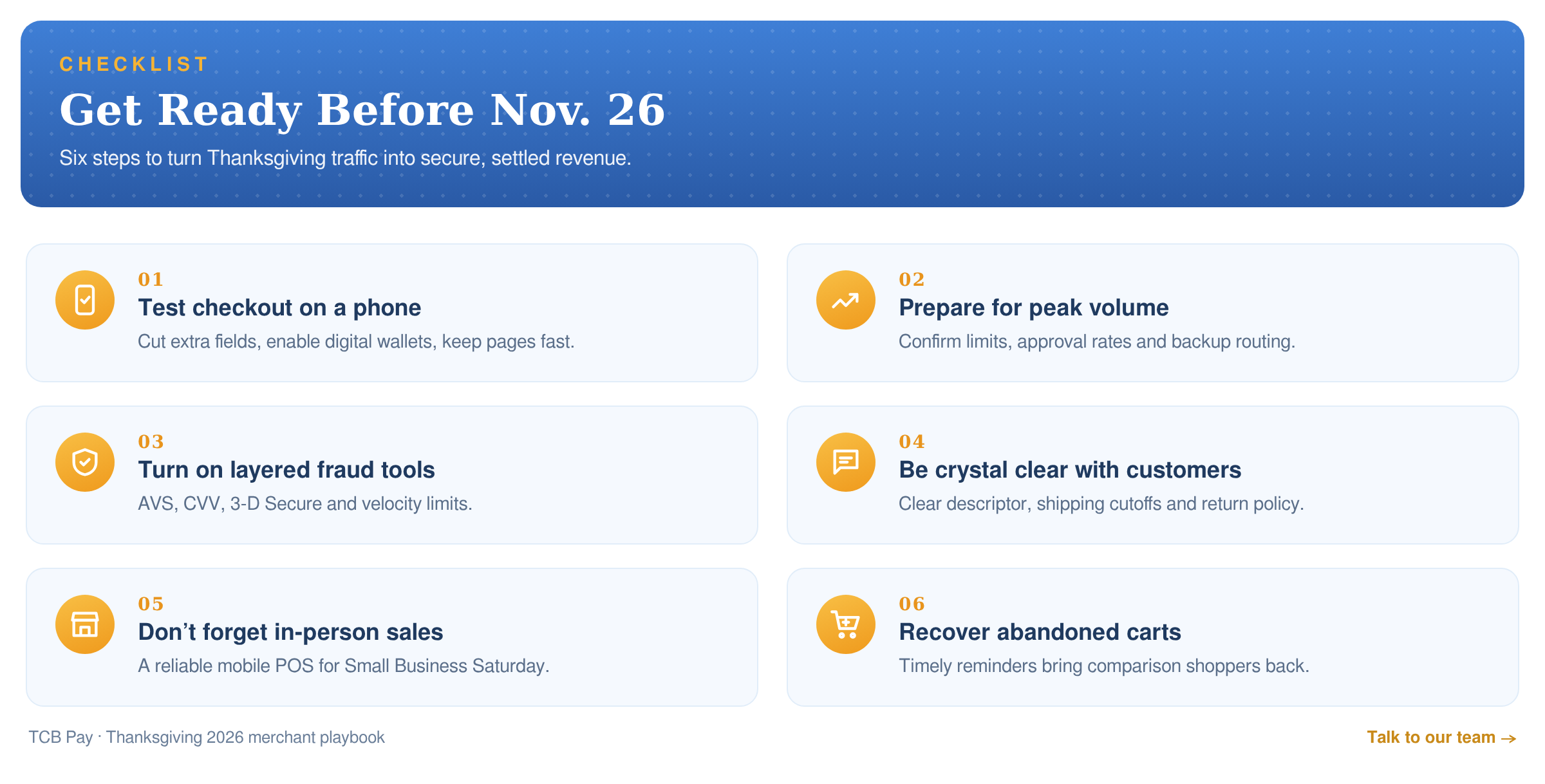
You still have time to get ready. Here's what we recommend doing before Nov. 26:
- Test your checkout on a phone. Go through a full purchase on mobile. Cut extra fields, enable digital wallets, and make sure pages load fast.
- Make sure your processing can handle the peak. Talk to your payment partner about volume limits, approval rates, and backup routing so a spike at 9 p.m. on Cyber Monday doesn't become a wave of declines.
- Turn on layered fraud tools. Use AVS, CVV, and 3-D Secure, set velocity limits to catch card testing, and review unusually large or rushed orders.
- Be crystal clear with customers. Use a recognizable billing descriptor, and post your holiday shipping cutoffs and return policy where shoppers can see them. Confusion is one of the biggest causes of chargebacks.
- Don't forget in-person sales. Small Business Saturday is built for local shops. A reliable mobile POS lets you take payments at the counter, at a pop-up, or in line.
- Recover abandoned carts. Holiday shoppers compare prices across tabs. A timely reminder email can bring them back — here's more on reducing cart abandonment.
The bottom line
Thanksgiving is more than a holiday — it's the starting line for the most important sales season of the year. With 2026 holiday sales expected to pass $1 trillion, shoppers moving to mobile and flexible payments, and fraudsters waiting in the crowd, the merchants who prepare now will be the ones who keep more of what they earn.
At TCB Pay, we pride ourselves on being a partner you can trust when it matters most. Whether you're serving holiday diners, running a Black Friday sale online, or welcoming neighbors on Small Business Saturday, we're here to help you get paid quickly, securely, and with peace of mind. Happy Thanksgiving from all of us!

 Free Demo with Chris